GHK-Cu (glycyl-L-histidyl-L-lysine copper) is a naturally occurring copper-binding peptide with diverse biological activities. Research spans its molecular structure, cellular mechanisms, antioxidant properties, anti-inflammatory pathways, and gene modulation studies.
Molecular Structure and Copper Binding
GHK-Cu forms a stable complex with copper(II), coordinating through three nitrogen atoms and one oxygen atom, with a dynamic fifth bond from the C-terminal carboxylate.
This structure is stable in both solid and solution states, and the peptide exhibits high affinity for copper, facilitating its biological activity. The redox properties of GHK-Cu are distinct, with the complex being reducible and capable of releasing copper under certain conditions[1].
Skin Regeneration and Wound Healing
Research demonstrates GHK-Cu’s role in cellular remodeling processes. Studies show it influences synthesis of extracellular matrix components such as collagen, glycosaminoglycans, and decorin, and affects angiogenesis in tissue repair models[2].
These effects occur through increased production of growth factors and modulation of cytokine expression, affecting both breakdown and synthesis of dermal matrix components[3].
In cell and in vivo studies, GHK-Cu increased collagen and elastin production and improved skin elasticity. Topical application in nano-carriers significantly reduced wrinkle volume and depth compared to controls and commercial serum products[9].
Anti-Aging and Cosmetic Applications
GHK levels decline with age in biological systems. Research shows GHK-Cu exhibits anti-inflammatory and antioxidant effects in cellular models, counteracts cellular senescence, and affects cognitive parameters in aging studies[3][4].
Antioxidant and Anti-Inflammatory Pathways
Studies show GHK-Cu affects oxidative stress responses by regulating antioxidant gene expression, blocking reactive oxygen species, and processing harmful byproducts. Research demonstrates its modulation of inflammatory pathways in cellular and tissue models[4].
Hair Growth and Hair Loss Research
Research shows GHK-Cu increases proliferation of dermal papilla cells and keratinocytes in cell culture studies. Studies demonstrate enlarged hair follicle size and elongation in laboratory and animal models[6].
Research indicates GHK-Cu affects production of growth factors like vascular endothelial growth factor (VEGF) and basic fibroblast growth factor (bFGF) in experimental models[8].
Gene Expression Studies
GHK-Cu influences gene expression patterns in research models, reversing pathological gene signatures and affecting tissue integrity markers. Studies show it can shift gene expression from diseased to healthy patterns in experimental systems[5].
Research Delivery Methods
Due to its hydrophilicity, GHK-Cu presents absorption challenges in research applications. Advanced delivery systems, such as microneedles, nanocarriers, and ionic liquid-based microemulsions, have been developed for research purposes to enhance penetration and stability[4][7].
References
- Alshammari, N., & Platts, J. (2020). Theoretical study of copper binding to GHK peptide. Computational biology and chemistry, 86, 107265 . https://doi.org/10.1016/j.compbiolchem.2020.107265.
- Zoughaib, M., Luong, D., Garifullin, R., Gatina, D., Fedosimova, S., & Abdullin, T. (2020). Enhanced angiogenic effects of RGD, GHK peptides and copper (II) compositions in synthetic cryogel ECM model.. Materials science & engineering. C, Materials for biological applications, 120, 111660 . https://doi.org/10.1016/j.msec.2020.111660.
- Dou, Y., Lee, A., Zhu, L., Morton, J., & Ladiges, W. (2020). The potential of GHK as an anti-aging peptide.. Aging pathobiology and therapeutics, 2 1, 58-61 . https://doi.org/10.31491/apt.2020.03.014.
- Wang, Y., Lin, J., Yu, Z., Cheng, J., Cheng, J., & Cui, W. (2024). Rigid-flexible nanocarriers loaded with active peptides for antioxidant and anti-inflammatory applications in skin.. Colloids and surfaces. B, Biointerfaces, 236, 113772 . https://doi.org/10.1016/j.colsurfb.2024.113772.
- Pickart, L., & Margolina, A. (2021). Modulation of Gene Expression in Human Breast Cancer MCF7 and Prostate Cancer PC3 Cells by the Human Copper-Binding Peptide GHK-Cu.. , 05, 1-1. https://doi.org/10.21926/OBM.GENET.2102128.
- Pyo, H., Yoo, H., Won, C., Lee, S., Kang, Y., Eun, H., Cho, K., & Kim, K. (2007). The effect of tripeptide-copper complex on human hair growth in vitro. Archives of Pharmacal Research, 30, 834-839. https://doi.org/10.1007/BF02978833.
- Li, H., Low, Y., Chong, H., Zin, M., Lee, C., Li, B., Leolukman, M., & Kang, L. (2015). Microneedle-Mediated Delivery of Copper Peptide Through Skin. Pharmaceutical Research, 32, 2678-2689. https://doi.org/10.1007/s11095-015-1652-z.
- Tian, L., Luo, D., Chen, D., Zhou, H., Zhang, X., Yang, X., Wang, Y., & Liu, W. (2022). Co-delivery of bioactive peptides by nanoliposomes for promotion of hair growth. Journal of Drug Delivery Science and Technology. https://doi.org/10.1016/j.jddst.2022.103381.
- Badenhorst, T., Svirskis, D., Merrilees, M., Bolke, L., & Wu, Z. (2016). Effects of GHK-Cu on MMP and TIMP Expression, Collagen and Elastin Production, and Facial Wrinkle Parameters. Journal of Aging Science, 4, 1-7. https://doi.org/10.4172/2329-8847.1000166.



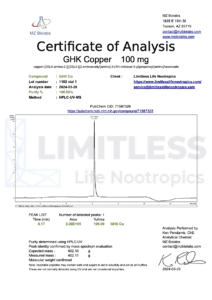

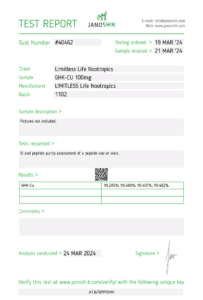




Reviews
There are no reviews yet.